
- Home
- »
- Food Additives & Nutricosmetics
- »
-
Industrial Hemp Market Size And Share Report, 2026-2033GVR Report cover

Industrial Hemp Market (2026 - 2033)
Size, Share & Trends Analysis Report By Product (Seeds, Fiber, Shives), By Application (Textiles, Personal Care, Food & Beverages, Animal Care), By Region, And Segment Forecasts
Market Size, 2025
$7.5BMarket Estimate, 2026
$8.8BMarket Forecast, 2033
$27.7BCAGR, 2026–2033
17.9%Industrial Hemp Market Summary
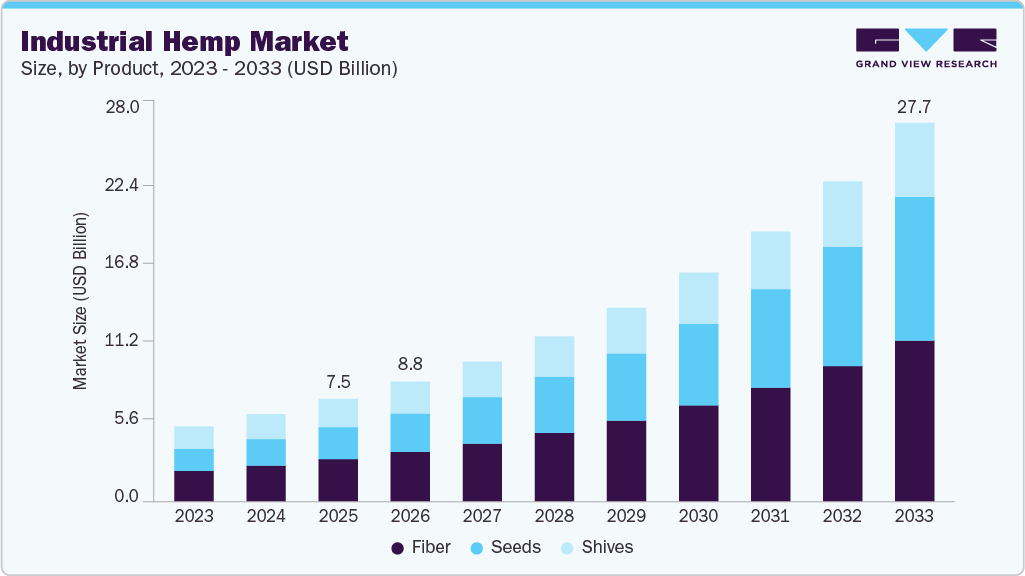
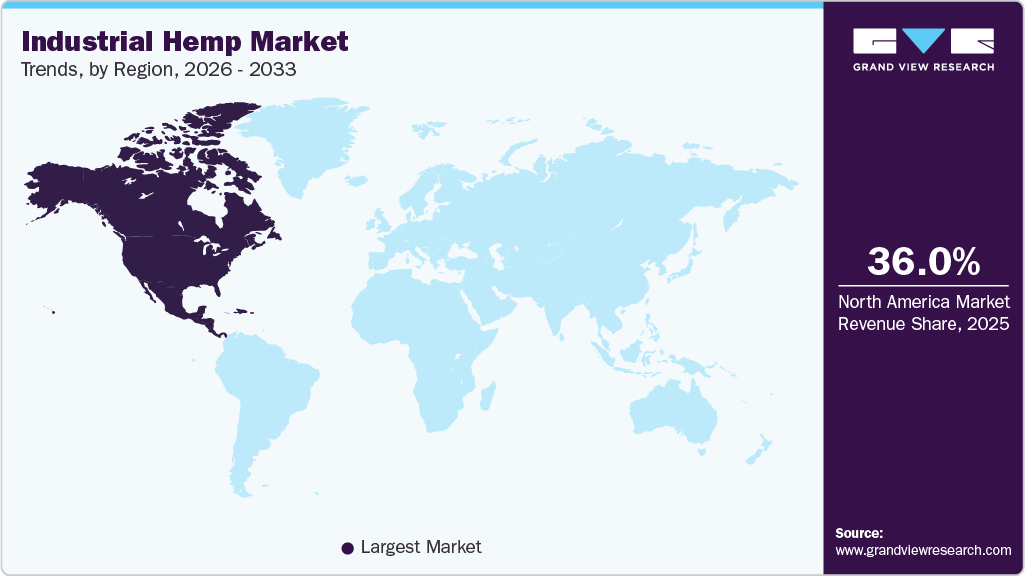
The global industrial hemp market size was valued at USD 7.5 billion in 2025 and is projected to grow from USD 8.8 billion in 2026 to USD 27.7 billion by 2033, at a CAGR of 17.9% from 2026 to 2033. North America dominated the global market, accounting for a revenue share of 36.0% in 2025. Global market growth is supported by favorable regulatory developments, established cultivation capabilities, and the increasing commercialization of hemp-derived products.
 Source: Grand View Research, IR Documents, Primary Interviews, Paid DatabasesTo learn more about this report,
 Download Free Sample Report
Key Market Trends & Insights
- By product: Fiber segment held the largest revenue share of 41.3% in 2025.
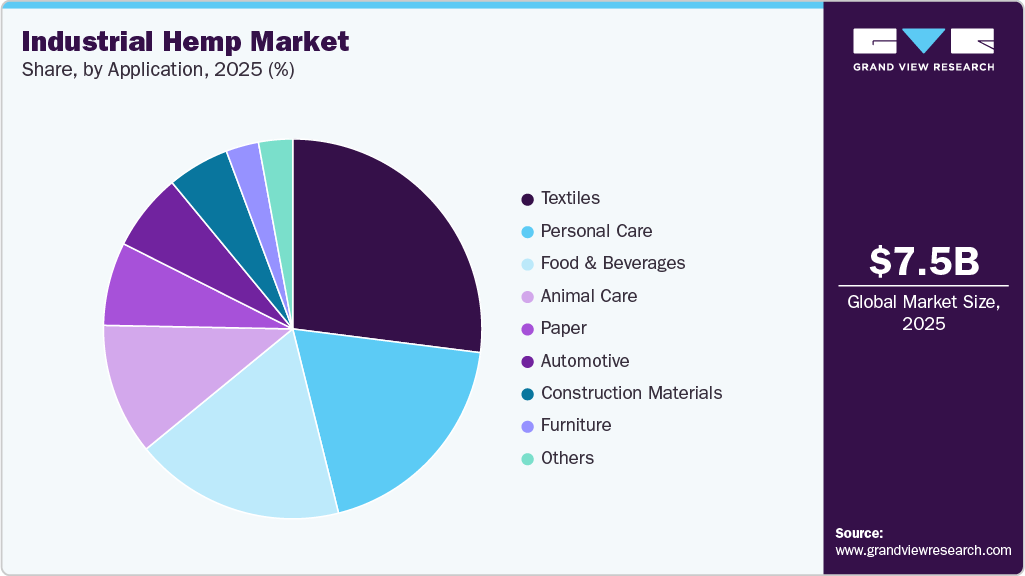
- By application: Textiles segment held the largest revenue share of 27.0% in 2025.
Regional Highlights
- Largest regional market: North America (36.0% revenue share, 2025)
- Fastest-growing regional market: North America (fastest CAGR 20.7%, 2026-2033)
Market Size & Forecast
- Market size in 2025: USD 7.5 Billion
- Estimated market size in 2026: USD 8.8 Billion
- Projected market size by 2033: USD 27.7 Billion
- CAGR (2026-2033): 17.9%
Three ways to get this report
Buy it, customize it, or ask a question.Ask an Analyst
Analyst response in 1 business day
- AccessReport author, directly
- Reply timeWithin 1 working day
- No sales callDirect answer only
- FormatEmail reply
- CostFree, no cost
Get the Full Report
What the study covers
- FormatsPDF · Excel · Dashboard
- Timeline2026–2033 annual, 2025 base
- Coverage20+ countries, 5 regions
- Companies10+ key players profiled
Customize the Report
20% free customization
- IncludeCountries, segments, points
- TailorTo your product definition
- ExtendDeeper competitor detail
- OrA fully bespoke study
- Turnaround5–10 working days
Rising demand for sustainable and eco-friendly materials across industries such as textiles, construction, and packaging is also significantly contributing to the growth. The industrial hemp industry is gaining momentum as manufacturers and consumers increasingly prioritize renewable, low-impact materials and plant-based ingredients. Hemp offers a compelling sustainability profile, requiring comparatively less water, pesticides, and fertilizer than conventional crops such as cotton. These characteristics are increasing its relevance across textiles, construction, packaging, automotive, and other industries seeking to lower environmental impacts. Hemp fiber, hempcrete, and hemp-based bioplastics are consequently attracting greater interest as alternatives to conventional materials, while supporting corporate sustainability objectives and the transition toward circular economy models.Beyond industrial applications, the expanding consumption of hemp-derived products in food, beverages, personal care, and pharmaceuticals is creating additional avenues for market growth. Hemp seeds and oil provide protein, essential fatty acids, and other nutrients, supporting their incorporation into functional foods, nutritional supplements, protein powders, snacks, and beverages. Growing consumer interest in plant-based diets is further strengthening this demand. Similarly, hemp-derived ingredients are gaining traction in skincare and cosmetic formulations, where their moisturizing and skin-conditioning characteristics are supporting broader product development and creating new commercial opportunities for manufacturers.
 To learn more about this report, Download Free Sample Report
Regulatory developments are also influencing the pace of industry expansion by improving the legal framework for cultivation and processing in several major markets. North American and European markets have increasingly differentiated industrial hemp from psychoactive cannabis based on THC thresholds, encouraging cultivation, investment, and product innovation. According to the European Commission, hemp cultivation is eligible for support under the Common Agricultural Policy (CAP), provided that the cultivated varieties meet the applicable THC content and certification requirements. For CAP direct payments, eligible hemp varieties must have a THC content of no more than 0.3%. The Commission further identifies France, Poland, and Romania as EU Member States providing coupled income support for hemp cultivation.
At the farm level, improving awareness of hemp’s potential yields, diversified end uses, and income opportunities is encouraging greater interest among growers seeking alternatives to conventional crops. Nevertheless, regulatory requirements, cultivation standards, and product-specific compliance obligations remain important considerations for market participants. Continued regulatory evolution, increasing commercial acceptance, technological development, and diversification into higher-value applications are therefore expected to support sustained market expansion across developed and emerging economies.
Market Dynamics
The growing preference for eco-friendly products in thermal insulation, construction materials, fiberglass alternatives, and automotive products is expected to drive the market over the forecast period. The growing demand for technical products such as oil paints, varnishes, printing inks, fuel, solvents, chain saw lubricants, putty, and coatings is expected to have a major impact on the market’s growth. Industrial hemp cultivation, harvesting, and processing are associated with increased research and development to develop new genetic improvements, refine agronomy, and advanced technologies to achieve high yields and premium-quality products. Highly advanced equipment is used to process hemp into high-quality fiber, seed oil, hurds, flour, and other products used to manufacture consumer products such as protein supplements, granola bars, salad oil, and effective skin care products. Population growth, coupled with rising per capita disposable income, is expected to increase demand for high-quality cosmetics and personal care products, as well as protein supplements and other health food products. Such factors are expected to be among the key market growth drivers.
The industrial hemp market is driven by rising demand across diverse application industries, including textiles, personal care, food & beverage, automotive, construction, furniture, paper, and agriculture. Hemp fiber is increasingly utilized in textiles, yarns, paper, insulation, carpeting, home furnishings, composites, and automotive components, while hemp hurds are gaining use in animal bedding, paper, and absorbent materials. Hemp-based oils and seeds are also witnessing growing adoption in food, nutritional products, cosmetics, and personal care formulations, supported by their nutritional composition and favorable fatty acid profile.
Demand is further supported by the functional properties of hemp-derived materials, which enable their application across performance-oriented industries. Hemp fiber offers high tensile strength, durability, absorbency, and resistance to mildew, making it suitable for textiles, packaging, construction materials, and bio-composites. Its strength-to-weight characteristics are particularly relevant for automotive components, fiberboards, and lightweight composite applications. Meanwhile, hemp hurds provide value in insulation, animal bedding, and absorbent products. Expanding adoption of these materials across conventional and emerging applications is expected to broaden the market's addressable opportunities.
Stringent and evolving government regulations remain a key restraint for the industrial hemp market, as cultivation, processing, distribution, and commercialization are subject to licensing, THC limits, approved cultivars, and testing requirements that vary across countries and jurisdictions. In addition, regulatory uncertainty surrounding hemp-derived cannabinoids, limited processing infrastructure, inconsistent standards, high compliance costs, and concerns regarding potential diversion into illicit cannabis markets can increase operational complexity and discourage investment. These regulatory and supply-chain challenges may constrain large-scale cultivation and cross-border trade, particularly in emerging markets where standardized hemp frameworks and processing capabilities remain underdeveloped.
The growing transition toward bio-based and circular materials presents significant opportunities for industrial hemp producers and downstream manufacturers. Increasing adoption of hemp fiber, hurd, biocomposites, hempcrete, and bioplastics across automotive, construction, packaging, textiles, and furniture can create new demand beyond traditional hemp applications. In parallel, rising interest in plant-based nutrition, functional foods, natural personal care ingredients, and wellness products is expanding opportunities for hemp seeds, oils, and other value-added derivatives.
Further opportunities are emerging from vertical integration, product innovation, and the development of application-specific hemp materials. Advances in processing technologies can improve fiber quality, consistency, and scalability, enabling hemp to compete more effectively with conventional raw materials. Partnerships between hemp growers, processors, material manufacturers, and consumer brands could also strengthen supply chains and accelerate commercialization. As companies pursue lower-carbon inputs and governments promote bio-based industries, industrial hemp has the potential to capture emerging demand for renewable materials while opening higher-margin opportunities across specialty and performance-oriented applications.
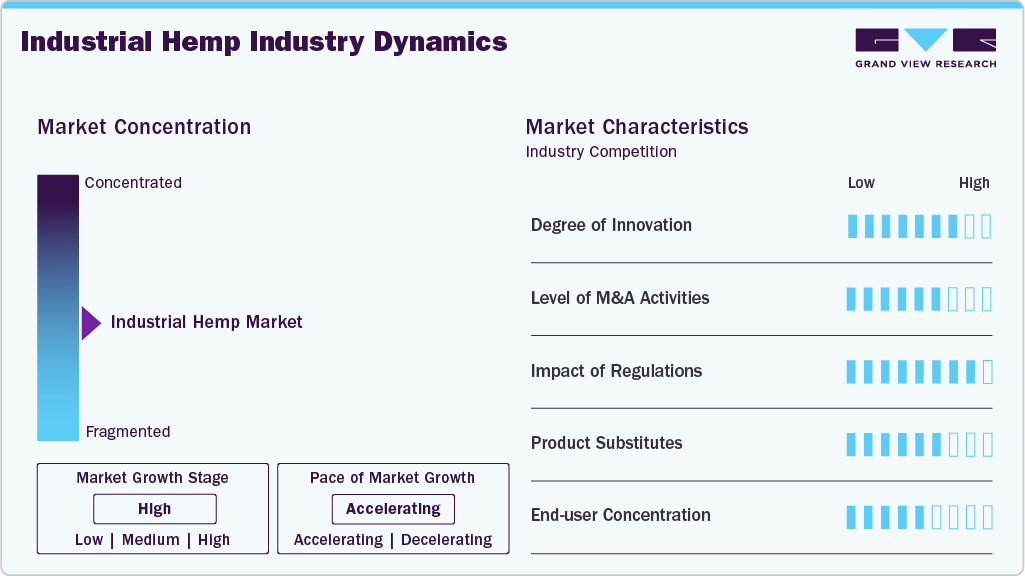
Market Concentration & Characteristics
The industrial hemp industry remains characterized by uneven regulatory maturity and varying levels of market development across geographies. Although cultivation is permitted in an increasing number of countries, differences in permissible THC concentrations, licensing procedures, cultivation standards, and rules governing downstream processing continue to create a complex operating environment. Regulatory predictability is generally stronger in established markets such as North America and Europe, whereas several markets across Asia Pacific and Latin America are still developing comprehensive frameworks. This disparity influences investment decisions, market entry strategies, and the pace at which commercial-scale cultivation can expand.
 To learn more about this report, Download Free Sample Report
Infrastructure and value-chain capabilities represent another important structural consideration. Specialized facilities for decortication, fiber separation, extraction, and further processing remain limited in numerous producing regions, restricting the availability of standardized, high-quality hemp inputs and contributing to logistics and production inefficiencies. At the same time, increasing capital deployment is encouraging technological advancement, capacity expansion, and greater vertical integration. Market participants are increasingly seeking control across cultivation, primary processing, and downstream manufacturing to strengthen supply reliability, improve cost efficiency, enhance product consistency, and capture greater value across the hemp supply chain.
Analyst Perspective
Over the next decade, industrial hemp is expected to evolve from a niche agricultural commodity into a diversified bio-based industrial platform. Growth of the market is projected to be driven by demand for renewable fibers, low-carbon construction inputs, bio-composites, functional foods, and specialty ingredients, rather than dependence on any single end-use category. Regulatory harmonization, improved cultivation genetics, and investment in processing infrastructure will determine how rapidly supply chains mature. The principal differentiator will shift from acreage to material performance and supply reliability. Producers capable of delivering consistent fiber specifications, certified seed, traceable sourcing, and scalable processing will have an advantage over fragmented suppliers. Over the coming years, competitive positioning is likely to depend on regulatory credibility, processing efficiency, and application-specific innovation.
Product Insights
The fiber segment dominated the industrial hemp industry in 2025, accounting for 41.3% of the total revenue share. Its leading position is supported by the broad applicability and favorable performance characteristics of hemp fiber, including high tensile strength, durability, lightweight properties, and biodegradability. Its strong mechanical properties, biodegradability, and alignment with sustainability trends have made it a preferred alternative to synthetic fibers and conventional materials. Demand is particularly strong across textiles, automotive composites, construction materials, insulation, paper, packaging, and furniture, where manufacturers are increasingly seeking renewable alternatives to conventional synthetic and natural materials. Growing emphasis on sustainable sourcing and lower-carbon manufacturing is further encouraging the incorporation of hemp fiber into industrial applications, supporting continued segment growth over the forecast period.
The seeds segment is projected to grow at the fastest CAGR of 20.6% during the forecast period, supported by increasing consumer demand for plant-based, nutrient-dense, and functional food ingredients. Hemp seeds offer a combination of high-quality protein, essential fatty acids, fiber, and other nutrients, making them suitable for protein powders, nutrition bars, snacks, dairy alternatives, beverages, and bakery products. Rising adoption of vegan, vegetarian, organic, and clean-label diets is further expanding their consumption across developed and emerging markets. In addition, growing product innovation by food manufacturers and the incorporation of hemp seeds into health and wellness formulations are expected to create new avenues for segment expansion. Increasing retail availability and consumer awareness of hemp seed nutrition are also likely to support sustained demand over the forecast period.
Application Insights
The textiles segment dominated the industrial hemp market, accounting for a revenue share of 27.0% in 2025, driven by rising demand for sustainable and durable fibers as alternatives to cotton and synthetic materials. The textiles segment is also expected to grow at the fastest CAGR of 20.2% in terms of revenue over the forecast period. Industrial hemp fiber, primarily bast fiber, is widely used in the manufacture of textiles, including consumer and technical fabrics. Consumer products include apparel, diapers, fabrics, handbags, working clothes, denim, socks, shoes, and fine textiles manufactured from cottonized fibers. Industrial hemp fabric is stronger and requires fewer toxic chemicals and less freshwater to grow and for commercial use than cotton fabric. Hemp fabric can also be blended with cotton or linen, which adds stretch and strength to hemp and makes the resulting fiber softer and more comfortable. Companies such as Hemp Fortex offer a range of hemp-blended fabrics for apparel and textile applications, reflecting the increasing commercialization of hemp-based materials in the global textile industry.
 To learn more about this report, Download Free Sample Report
The personal care application segment is witnessing strong demand for industrial hemp, and is expected to record a CAGR of 20.0% over the forecast period, supported by increasing consumer inclination for natural, plant-derived, and organic ingredients in skincare and cosmetic formulations. Hemp seed oil is one of the richest sources of polyunsaturated fats, including both essential fatty acids (Omega-3 and Omega-6) and GLA (gamma linolenic acid); it is also an excellent natural emollient and moisturizer. Body care products containing hemp seed oil reduce skin discomfort by soothing and restoring dry or damaged skin. Rising consumer preference for clean-label, plant-based beauty products is further encouraging its incorporation across skincare, haircare, body care, and cosmetic products. In addition, growing product innovation around hemp-based formulations and increasing availability through specialty and mainstream retail channels are creating new opportunities for manufacturers. The broader shift toward wellness-oriented and environmentally conscious beauty products is also expected to strengthen demand for hemp-derived personal care ingredients.
Regional Insights
The North America industrial hemp market dominated with a revenue share of 36.0% in 2025, supported by established cultivation frameworks, expanding processing capabilities, and growing commercial adoption across diverse end-use industries. The region is witnessing increasing demand for hemp fiber, seeds, oil, food ingredients, textiles, construction materials, and personal care products. Growing investments in processing infrastructure, product innovation, and supply-chain development are further strengthening regional competitiveness. However, evolving regulations surrounding cannabinoid-derived products are increasing compliance requirements and creating a more differentiated market environment, particularly in the U.S.
 To learn more about this report, Download Free Sample Report
The U.S. industrial hemp market remains key, driven by its established agricultural ecosystem, expanding cultivation base, and large-scale farming capabilities that facilitate a relatively consistent supply of raw materials. The market is witnessing broader adoption of hemp across fiber, grain, seed, food ingredients, textiles, construction materials, biocomposites, and personal care applications. Increasing investment in domestic processing infrastructure is also improving opportunities to convert locally cultivated hemp into higher-value products. At the same time, evolving federal and state-level regulations, particularly those governing hemp-derived cannabinoids and THC content, are reshaping the competitive landscape and increasing the importance of product testing, traceability, and regulatory compliance. Growing interest in sustainable materials and plant-based ingredients is expected to further support commercial demand for industrial hemp across the U.S.
Asia Pacific Industrial Hemp Market Trends
The Asia Pacific industrial hemp industry is expected to grow at a CAGR of 19.3% over the forecast period, supported by expanding cultivation, competitive production economics, increasing regulatory acceptance, and growing applications across food, textiles, personal care, and industrial materials. Countries such as China, India, and Thailand benefit from favorable labor costs and established agricultural capabilities, enabling the production of competitively priced hemp seed and fiber. Increasing global demand, coupled with advancements in cultivation, harvesting, and processing technologies, is improving productivity and encouraging commercialization across the region. In addition, rising consumption of hemp-based foods, nutritional supplements, and functional ingredients in developing economies, supported by growing health awareness and an expanding geriatric population, is expected to create further opportunities. The region’s growing textile and bio-based manufacturing industries, combined with increasing interest in sustainable raw materials, are also expected to strengthen demand for hemp fiber and other industrial applications.
China is one of the world’s leading producers of industrial hemp and hemp-derived products, supported by a long-established cultivation base and a well-developed supply chain. The country’s extensive spinning and processing infrastructure for natural fibers, combined with competitive labor costs, has enabled the development of a highly competitive hemp textile industry capable of supplying cost-effective products to international markets. China is also a major global supplier of both raw and processed hemp fiber and serves as an important source of hemp materials for markets such as the U.S. In addition, China produces hempseed at relatively competitive costs; however, requirements associated with the sterilization of imported seeds can increase costs and potentially affect grain quality.
Key Industrial Hemp Company Insights
The industrial hemp market is moderately fragmented, with regional cultivators, processors, specialized manufacturers, and vertically integrated players competing across multiple end-use segments. Leading companies are prioritizing capacity expansion, processing efficiency, product innovation, and vertical integration to secure raw material supply, strengthen margins, and improve product consistency. Strategic partnerships and collaborations are also increasing, particularly in high-value applications such as textiles, bioplastics, food, and personal care. Meanwhile, emerging companies are leveraging sustainability trends and application-specific innovation, while established players are investing in advanced processing technologies and differentiated product portfolios to strengthen their competitive positioning.
Terra Tech Corp.; Hemp, Inc.; and Parkland Industrial Hemp Growers Cooperative Ltd. are some of the major players in the market involved in the research and development activities to develop perfect agronomy and varieties of industrial hemp. The companies primarily invest in developing different products from industrial hemp, such as hemp oil, personal care products, protein powders, energy bars, textiles, food and beverage products, and automotive and construction materials.
Key Industrial Hemp Companies
The following key companies have been profiled for this study on the industrial hemp market.
-
CBD Biotechnology Co
-
Botanical Genetics, LLC
-
Marijuana Company of America Inc.
-
Terra Tech Corp.
-
American Cannabis Company, Inc.
-
Industrial Hemp Manufacturing, LLC
-
Hemp, Inc.
-
Boring Hemp Company
-
Plains Industrial Hemp Processing Ltd.
-
Ecofiber Industries Operations
Recent Developments
-
In January 2026, New York State invested USD 1 million in a cutting-edge hemp manufacturing lab at Rensselaer Polytechnic Institute (RPI) focused on converting industrial hemp into construction materials, textiles, and packaging products. This initiative will transform hemp fibers into structural blocks, natural-fiber rebar, insulated panels, and siding, addressing construction's high carbon emissions while building a local circular bioeconomy.
-
In December 2025, HempFlax B.V. and C-biotech announced the acquisition of Kingspan’s hemp-insulation production facility in Nördlingen, Germany. The operations were transferred to a new joint venture, C-HempFlax Building Solutions GmbH, effective November 1, 2025. The transaction is intended to expand production of hemp-based insulation and strengthen the companies’ position in bio-based and circular construction materials.
Industrial Hemp Market Report Scope
Report Attribute
Details
Market size in 2025
USD 7.5 billion
Estimated market size in 2026
USD 8.8 billion
Projected market size by 2033
USD 27.7 billion
Growth rate
CAGR of 17.9% from 2026 to 2033
Base year for estimation
2025
Historical data
2021 - 2024
Forecast period
2026 - 2033
Quantitative units
Revenue in USD billion, volume in tons, and CAGR from 2026 to 2033
Report coverage
Revenue forecast, volume forecast, company ranking, competitive landscape, growth factors, and trends
Segments covered
Product, application, and region
Regional scope
North America; Europe; Asia Pacific; Latin America; Middle East & Africa
Country scope
U.S.; Canada; Mexico; Germany; UK; France; China; India; Japan; Brazil
Key companies profiled
Parkland Industrial Hemp Growers Cooperative Ltd.; CBD Biotechnology Co.; Botanical Genetics, LLC; Marijuana Company of America Inc.; HempMeds Brasil; Terra Tech Corp.; American Cannabis Company, Inc.; HempFlax B.V.; Industrial Hemp Manufacturing, LLC; American Hemp; Hemp, Inc.; Boring Hemp Company; Plains Industrial Hemp Processing Ltd.; Ecofiber Industries Operations; Valley Bio Limited
Customization scope
Free report customization (equivalent to up to 8 analysts working days) with purchase. Addition or alteration to country, regional & segment scope.
Pricing and purchase options
Avail of customized purchase options to meet your exact research needs. Explore purchase options
Global Industrial Hemp Market Report Segmentation
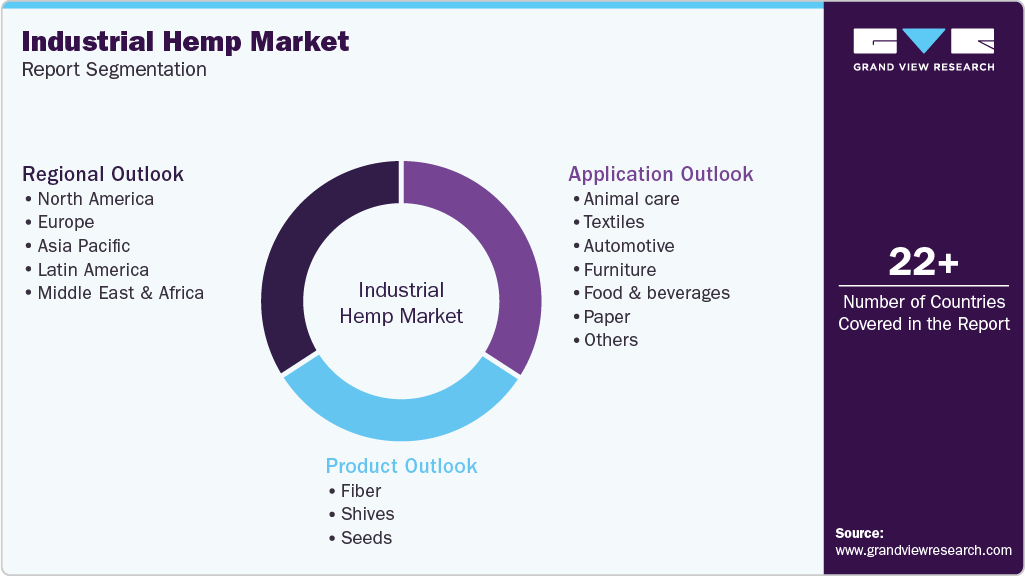
This report forecasts revenue & Volume growth at the global, regional & country levels and provides an analysis of the latest industry trends in each of the sub-segments from 2021 to 2033. For this study, Grand View Research has segmented the global industrial hemp market report based on product, application, and region:
 To learn more about this report, Download Free Sample Report
-
Product Outlook (Volume, Tons; Revenue, USD Billion, 2021 - 2033)
-
Fiber
-
Shives
-
Seeds
-
-
Application Outlook (Volume, Tons; Revenue, USD Billion, 2021 - 2033)
-
Animal care
-
Textiles
-
Automotive
-
Furniture
-
Food & beverages
-
Paper
-
Construction materials
-
Personal care
-
Others
-
-
Regional Outlook (Volume, Tons; Revenue, USD Billion, 2021 - 2033)
-
North America
-
U.S.
-
Canada
-
Mexico
-
-
Europe
-
Germany
-
UK
-
France
-
-
Asia Pacific
-
China
-
India
-
Japan
-
-
Latin America
-
Brazil
-
-
Middle East & Africa
-
Frequently Asked Questions About This Report
North America dominated the industrial hemp market with a share of 36.0% in 2025, owing to rising production and consumption of industrial hemp in the region coupled with the presence of well-established market players with robust supply chains.
Key factors that are driving the market growth include rising demand from the application industries coupled with agricultural and environmental product benefits.
Key players include Parkland Industrial Hemp Growers Cooperative Ltd., CBD Biotechnology Co., Botanical Genetics, LLC, Marijuana Company of America Inc., HempMeds Brasil, Terra Tech Corp., American Cannabis Company, Inc., HempFlax B.V., Industrial Hemp Manufacturing, LLC, American Hemp, Hemp, Inc., Boring Hemp Company, Plains Industrial Hemp Processing Ltd., Ecofiber Industries Operations, and Valley Bio Limited.
The global industrial hemp market size was valued at USD 7.5 billion in 2025 and is estimated at USD 8.8 billion for 2026.
The global industrial hemp market is expected to grow at a CAGR of 17.9% from 2026 to 2033, reaching USD 27.7 billion by 2033.
The fiber segment led with a 41.3% revenue share in 2025, while the seeds is the fastest-growing product.
The textiles segment accounted for the largest revenue share of 27.0% in 2025.
About the Author(s)
Food Additives & Nutricosmetics Research Team
Specialty & Chemicals · Food Additives & NutricosmeticsThis report was authored by the food additives & nutricosmetics research team at Grand View Research - comprising two research analysts, one senior research analyst, and one industry expert - with specialized expertise in the food additives & nutricosmetics segment of the specialty & chemicals industry. All findings are based on proprietary specialty & chemicals databases, executive interviews, and regulatory analysis, subject to internal peer review prior to publication.
Last Updated:
Speak to Analyst

Customize this report to your needs - add regions, segments, or data points, with 20% free customization.
Or view our licence options:


ISO 9001:2015 & 27001:2022 Certified
We are GDPR and CCPA compliant! Your transaction & personal information is safe and secure. For more details, please read our privacy policy.


